Categories
The Persona Spark: Igniting Personal Development

Explainsplaining: A Comedy of Errors (and Egos)

Let’s talk explainsplaining. It’s a phenomenon so ubiquitous, so ingrained in the fabric of human interaction, that we almost don’t even notice it anymore. It’s that special brand of patronizing communication where someone, regardless of gender, treats your intellect like a dusty old rotary phone in a world of smartphones. They approach you with the implicit assumption that your cognitive hard drive is perpetually defragmenting, requiring a hefty deposit of their superior knowledge. It’s like they’re convinced you’ve wandered into the conversation wearing a metaphorical “Please Explain Everything to Me, I’m Clearly an Idiot” t-shirt.
Now, I’ll confess. I’ve been on both sides of this conversational tightrope. I’ve received explanations so condescending they could make a saint question their faith in humanity. I remember once discussing astrophysics with someone who proceeded to explain gravity to me as if I’d just crawled out from under a rock. (Spoiler alert: I have a degree in astrophysics. The irony was not lost on me.) And, if I’m being brutally honest, I’ve probably been guilty of a little explainsplaining myself. It’s a human frailty, this irresistible urge to share our “wisdom,” even when it’s about as welcome as a fruitcake at a Weight Watchers meeting.
Think of it like this: you’re discussing the finer points of 18th-century French literature, and someone chimes in with, “Well, you see, it’s all about, like, words…” It’s as if they’re explaining the concept of “wet” to someone who’s just emerged from a swimming pool. My brain, in these moments, stages a full-blown internal revolt. It’s like an orchestra conductor suddenly realizing that all his musicians have replaced their instruments with kazoos. Chaos.
Why do we do this to each other? Is it insecurity masquerading as expertise? Is it the intoxicating allure of the “aha!” moment, even if that “aha!” is entirely fabricated? Sometimes, I suspect it’s a genuine (though woefully misguided) attempt to connect. They think they’re filling a void, when really, they’re just creating a conversational black hole.
As the inimitable Dorothy Parker once quipped, “The cure for boredom is curiosity. There is no cure for explainsplaining.” (Okay, she didn’t actually say that, but it feels like something she would have said.)
So, how do we deal with these intellectual benefactors who are so eager to bestow upon us their precious nuggets of knowledge? Here are a few strategies I’ve found helpful:

  • The “So You’re Saying…” Parry: This is a classic. You summarize what they’ve just said (or, more accurately, what they think they’ve just said) in your own words, but with a slightly more sophisticated or nuanced twist. “So, you’re saying that the key to understanding quantum entanglement is…[insert your own, more insightful interpretation]? Interesting. I was also thinking about it in terms of [insert another, equally insightful perspective].”
  • The “But What About the Quantum Banana?” Diversion: (Use with extreme caution and a healthy dose of absurdist humor) This is my go-to when all else fails. You introduce a completely unrelated, slightly bizarre element into the conversation. “That’s a fascinating point. But it makes me wonder, what about the quantum banana? How does that factor into all of this?” This usually throws them off balance and gives you a chance to gracefully exit the conversation.
  • The “Existential Dread” Tactic: (Also use with caution, and only if you’re feeling particularly dramatic) You stare at them intently for a moment, as if contemplating the vastness of the universe and the inherent meaninglessness of existence. Then, you say, in a hushed voice, “Wow. That really puts things in perspective.” This usually leaves them speechless and gives you a chance to make your escape.
    Explainsplaining is a universal human comedy of errors (and egos). It’s not about gender; it’s about the eternal struggle for intellectual validation. By recognizing it, we can develop strategies to navigate these interactions with grace, humor, and maybe, just maybe, prevent our brains from feeling like they’ve just been subjected to a particularly tedious lecture on the history of the spork. After all, we all have our own unique “funds” of knowledge to contribute to the conversation. Let’s try to keep the intellectual ATMs from running on empty, shall we?

Categories
Reflections and Revelations: Lessons Scribbled in the Margins

Kids These Days: Coding, Creating, and Occasionally Crashing

Okay, let’s talk about freedom, shall we? It’s like that shiny new bike you got as a kid – exhilarating, right? Wind in your hair, the world whizzing by. That’s the kind of independence today’s youngsters enjoy – a far cry from the tricycle-riding days of previous generations. They’re practically zooming off into the sunset before they even learn to tie their shoelaces! It’s fantastic, really. Like watching a field of wildflowers burst into bloom – so much potential, so much vibrant energy.
Think about it: they’re building apps before they can drive, starting businesses from their bedrooms, and challenging the status quo with a click of a mouse. My own nephew, bless his heart, can code in Python before he can properly fold a fitted sheet. It’s mind-boggling! They’re a generation of digital natives, fluent in the language of the internet, masters of memes, and champions of change. They’re carving their own paths, blazing trails where once there were only footpaths. It’s like they’ve all been given a superpower – the power of choice, the power of access, the power to be.
But here’s the rub, the “but” that’s bigger than my ever-growing pile of laundry. Sometimes, all this freedom goes to their heads. It’s like giving that shiny new bike to a toddler without any training wheels. They’re off like a shot, full of enthusiasm, but lacking the finesse to navigate the bumps in the road. They might be so busy enjoying the wind in their hair that they forget there are other people on the sidewalk.
You know, it’s like that one person on the bus who plays their music so loud everyone else can hear it. Or the friend who’s always late, leaving everyone else twiddling their thumbs. Or the online troll who hides behind a screen, spewing negativity like a broken sprinkler. It’s not malicious, most of the time. It’s more like they’re so focused on their own movie that they forget everyone else is in the audience too. They’re so busy “expressing themselves” that they forget that expression shouldn’t come at the expense of others. As Spiderman’s uncle Ben wisely said, “With great power comes great responsibility.” And freedom, my friends, is a great power.
It’s like that old saying, “Your freedom ends where my nose begins.” A bit crude, maybe, but it makes the point. We need to teach them that freedom isn’t a free pass to be inconsiderate. It’s not about doing whatever you want, whenever you want. It’s about understanding that your actions have consequences, that your choices impact others. It’s about building empathy, about recognizing that the world doesn’t revolve around just you.
It’s a delicate balance, this whole freedom thing. We want to encourage their independence, nurture their creativity, and celebrate their individuality. But we also need to teach them about responsibility, about respect, about the art of being a decent human being. It’s like teaching them to ride that shiny new bike – with training wheels at first, then gradually letting go, until they’re confidently cruising down the road, aware of their surroundings, and sharing the path with others. That, my friends, is responsible freedom. And it’s something we all need to work on, young and old alike.

responsible freedom dipiction sketch
Categories
Rajath’s Canvas: Brushstrokes of Identity

Level 41 Unlocked: Slightly Used, But Still Runs Great!

Forty-one. It sounds like a software update, doesn’t it? Like I should suddenly have access to new features, maybe a built-in ability to be sophisticated (still no luck there), or at least a better understanding of cryptocurrency. Alas, no such luck. What I have unlocked is a profound appreciation for comfortable socks, the ability to nap anywhere, anytime, and the wisdom to know that attempting a cartwheel after two glasses of wine is a recipe for disaster.
Life at 41 is a delightful blend of the familiar and the surprising. It’s like that favorite worn-in t-shirt that you refuse to throw away. It’s comfortable, it’s familiar, it might have a few questionable stains, but it’s yours. You’ve earned those wrinkles, those gray hairs, those stories that start with “Remember that time…” You’ve learned that laughter is the best medicine (especially when combined with a good single malt), and that sometimes, the most productive thing you can do is absolutely nothing at all.
This year, I’m embracing the glorious, slightly chaotic, beautifully imperfect tapestry that is 41. I’m accepting the fact that my metabolism has officially left the building, and that my dance moves now resemble a confused giraffe. But I’m also celebrating the fact that I’ve survived (and even thrived) through life’s ups and downs. I’ve learned to appreciate the small joys: a perfectly ripe avocado, the sound of rain on a tin roof. And I’ve learned that the most valuable thing in the world is the love and laughter of the people I cherish.
Life at 41 is like a well-loved melody. I know the tune, I anticipate the crescendos and the quiet moments. I’ve learned to appreciate the nuances, the subtle shifts in tempo. I might not see the musicians, but I can hear the passion in their playing, the emotion in their notes. I’ve learned to listen deeply, to savor each moment, each interaction, each experience.
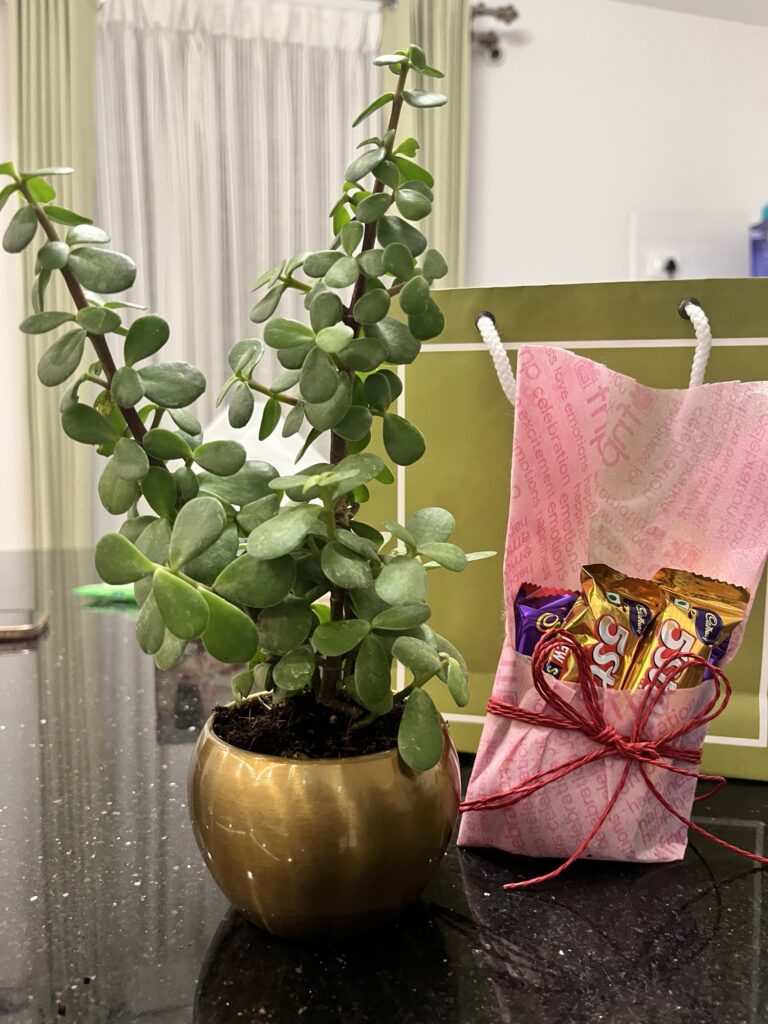
My dearest Sowmya, your midnight surprise

birthday gift from sowmya
Jade plant & bouquet of chocolates

was like a shooting star across the midnight sky—a fleeting moment of pure magic that lit up my entire world. It was the sweetest, most thoughtful gesture, a testament to your incredible ability to make me feel like the most loved man on earth. You have this uncanny knack for knowing exactly what I need, even before I know it myself. Seeing your face, beaming with that beautiful smile, as I opened your gift… it was the perfect start to my 41st. You’re not just my wife; you’re my soulmate, my partner in crime, the peanut butter to my jelly, the cheese to my macaroni, the… well, you get the idea. You’re the best part of me, and I love you more fiercely and deeply with each passing year. Thank you for making my life an adventure, a comedy, and a romance all rolled into one.
So, here’s to 41! May it be filled with joy, laughter, adventure, and the unwavering knowledge that I’m loved beyond measure. And may I finally figure out how to fold that darn fitted sheet. A man can dream, right?

Categories
Reflections and Revelations: Lessons Scribbled in the Margins

Epicureanism: It’s Not What You Think (But It Might Just Change Your Life)

Let’s talk happiness. Not the fleeting, Instagram-filter kind, but the deep-down, contented sigh of a cat draped over a sun-warmed windowsill. We’re diving into Epicureanism, and no, it’s not about endless toga parties (though a well-curated charcuterie board might make an appearance). Think of it as the philosophical equivalent of a perfectly balanced meal – not all decadent dessert, but a nourishing blend of flavors.
Epicureanism, at its core, whispers of maximizing pleasure and minimizing pain. Sounds simple, doesn’t it? Like something embroidered on a throw pillow. But the Epicureans were sharper than that. They knew true pleasure wasn’t the fleeting rush of instant gratification. It’s not about chasing the next dopamine hit like a caffeinated hummingbird flitting from flower to flower. That kind of pleasure is a sieve, constantly needing refilling. Instead, they sought ataraxia – tranquility, like a still pond reflecting a cloudless sky – and aponia – the absence of pain, like a gentle breeze rustling through leaves, not a howling storm.
How do you find this inner peace? Well, according to Epicurus, it’s not about running around like a squirrel burying nuts, frantically pursuing every whim. It’s about choosing wisely, like sinking into a well-worn armchair instead of perching on a trendy but uncomfortable stool. Imagine your life as a garden. Epicureanism isn’t about planting rare orchids demanding constant attention. It’s about cultivating sturdy, reliable herbs that offer consistent joy. Friendship, for example, is like a rosemary bush – resilient, fragrant, and always there to add flavor to your life.
“We must, therefore, consider what produces the pleasantest life, not to squander it on all sorts of desires, but to know which of them, when gratified, bring the greatest pleasure and for the longest time.” – Epicurus. That’s wisdom distilled. It’s like your grandmother saying, “Don’t chase every firefly, child. Focus on the ones that light up the whole night.”
Now, about those “pleasures.” Epicurus categorized them: natural and necessary (air to breathe, water to drink, a roof overhead), natural but not necessary (a gourmet meal, a silk robe), and neither natural nor necessary (fame, fortune, a diamond-encrusted phone case). He argued that true happiness blossoms from focusing on the first category. It’s Maslow’s hierarchy of needs with a philosophical lens. Picture yourself on a deserted island. You need the basics to survive. Then, maybe a comfy hammock. But if you’re agonizing over becoming the island’s supreme ruler, you’ve missed the point.
Epicureanism isn’t about denying yourself joy. It’s about being discerning about it. It’s choosing a rich, dark chocolate over a handful of sugary candies. It’s finding joy in the quiet moments – a well-loved book, a steaming cup of tea, a heartfelt conversation. It’s about nurturing inner peace, like a carefully tended bonsai, where the weeds of worry and fear are pruned away. And yes, perhaps a shared platter of artisanal cheeses with friends. Because even philosophers deserve a little indulgence.
So, take a quiet moment. Look at your own “garden.” What sturdy plants have you nurtured? What weeds need pulling? Where do you pour your precious energy – chasing fleeting whims or cultivating lasting joy? Consider what truly brings you ataraxia and aponia. You might be surprised by what you unearth.